
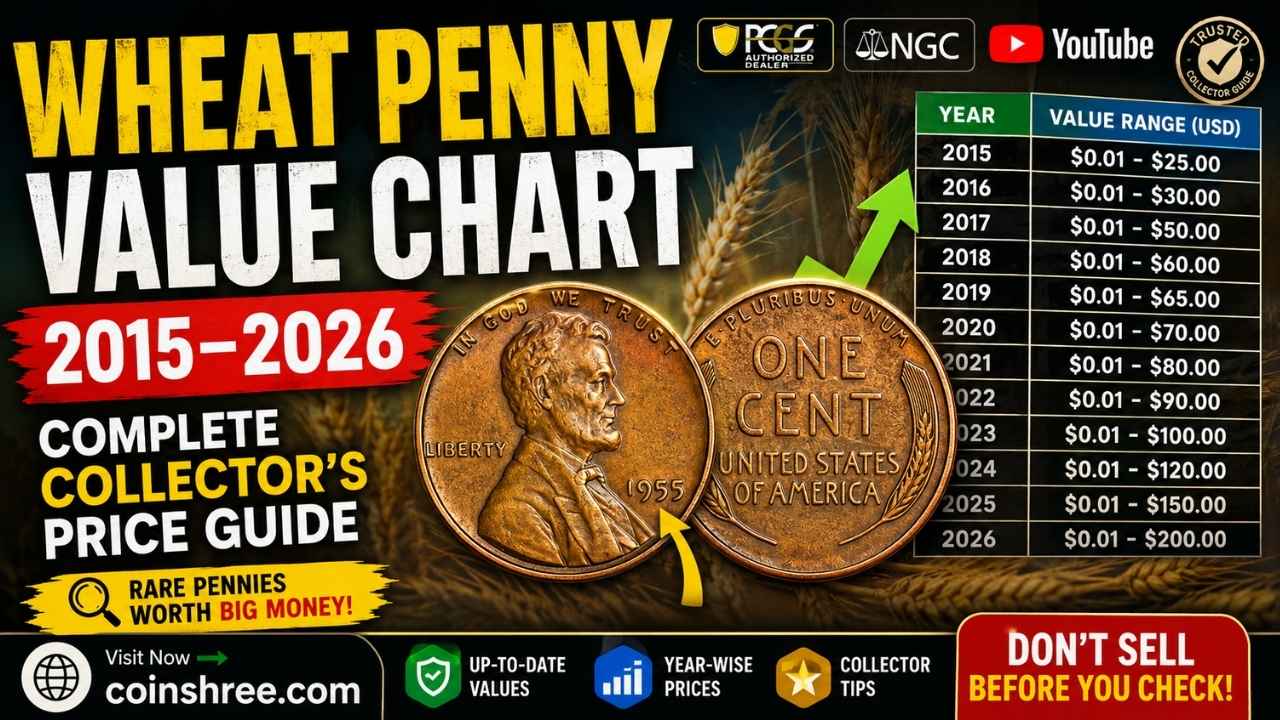
Wheat pennies continue to attract coin collectors across the world because of their history, rarity, and surprising market value. These coins were minted in the United States from 1909 to 1958 and feature two wheat stalks on the reverse side, which is why they are often called Wheat Cents or Wheat Pennies. Even today, people regularly discover these coins in old jars, inherited collections, flea markets, and estate sales.
The value of wheat pennies has increased steadily between 2015 and 2026 due to rising collector demand, inflation in rare coin markets, and growing online interest in vintage currency. Some common wheat pennies may only be worth a few cents, while rare editions can sell for thousands or even millions of dollars depending on condition and mint errors.
For beginners and experienced collectors alike, understanding the Wheat Penny Value Chart from 2015 to 2026 can help identify valuable coins and avoid selling rare pieces too cheaply.
History Behind Wheat Pennies
The wheat penny was first introduced in 1909 to celebrate the 100th birthday of President Abraham Lincoln. It became the first regular U.S. coin to feature a real historical figure instead of symbolic artwork.
Designed by Victor David Brenner, the coin displays Lincoln’s portrait on the front and two wheat ears on the back. Production continued until 1958 before being replaced by the Lincoln Memorial reverse design.
Collectors especially love wheat pennies because they represent an important period in American history including World War I, the Great Depression, and World War II.
Wheat Penny Value Chart 2015–2026
Below is an estimated collector value chart showing how average market prices changed over time for common and rare wheat pennies.
| Year | Common Wheat Penny Value | Rare Wheat Penny Value |
|---|---|---|
| 2015 | $0.03 to $1 | $200 to $5,000 |
| 2016 | $0.05 to $1.50 | $250 to $6,000 |
| 2017 | $0.05 to $2 | $300 to $7,500 |
| 2018 | $0.10 to $2.50 | $400 to $10,000 |
| 2019 | $0.10 to $3 | $500 to $12,000 |
| 2020 | $0.15 to $5 | $700 to $20,000 |
| 2021 | $0.20 to $6 | $1,000 to $35,000 |
| 2022 | $0.25 to $8 | $1,500 to $50,000 |
| 2023 | $0.30 to $10 | $2,000 to $75,000 |
| 2024 | $0.35 to $12 | $3,000 to $100,000 |
| 2025 | $0.50 to $15 | $5,000 to $250,000 |
| 2026 | $0.50 to $20 | $10,000 to $1 Million+ |
These values depend heavily on rarity, mint mark, historical importance, and coin condition.
Most Valuable Wheat Pennies Ever Found
Some wheat pennies are extremely valuable because of minting mistakes or limited production numbers.
The 1943 Bronze Wheat Penny is one of the most famous rare coins in American history. During World War II, pennies were supposed to be made from steel to save copper for military supplies. However, a few bronze coins were accidentally minted. One of these coins sold for over one million dollars.
Another highly valuable coin is the 1909 S VDB Wheat Penny. The initials of designer Victor David Brenner were placed prominently on the reverse side, causing controversy. Only a small number were produced before the initials were removed, making the coin highly collectible.
The 1955 Doubled Die Wheat Penny is also extremely popular because the date and lettering appear doubled due to a minting error.

Factors That Decide Wheat Penny Value
Several factors influence how much a wheat penny is worth in today’s collector market.
Coin condition is one of the biggest factors. Coins with little wear and strong details are worth much more than damaged or heavily circulated coins.
Mint marks also matter. Pennies minted in San Francisco or Denver can sometimes be rarer than those minted in Philadelphia.
Errors increase value significantly. Double dies, off center strikes, and wrong metal compositions can turn an ordinary penny into a rare collectible.
Demand among collectors continues to push prices upward, especially after 2020 when online coin collecting communities became more active.
How To Identify a Rare Wheat Penny
Collectors should carefully inspect every wheat penny before selling it.
Start by checking the year and mint mark. Key dates such as 1909 S, 1914 D, 1922 No D, 1931 S, 1943 Bronze, and 1955 Doubled Die are especially important.
Use a magnifying glass to examine lettering and numbers for doubling or unusual shapes. Weighing the coin can also help identify rare metal compositions.
Coins should never be cleaned aggressively because cleaning often lowers collector value.
Professional grading services can verify authenticity and provide official condition ratings that help increase resale value.
Why Wheat Penny Prices Rose After 2020
The period between 2020 and 2026 saw a major increase in coin collecting interest. Social media videos, online auctions, and digital collector communities introduced millions of new people to rare coins.
Inflation also played a role. As precious metals and collectibles became more valuable, vintage coins gained attention as alternative investments.
Many collectors began searching through old coin jars during lockdown periods, leading to viral discoveries of valuable pennies. This increased awareness pushed wheat penny prices higher in auction markets.
Best Places To Sell Wheat Pennies
Collectors have several options when selling wheat pennies.
Coin dealers provide quick evaluations and immediate payment. Online marketplaces allow sellers to reach larger audiences and potentially earn higher prices.
Auction houses are often the best choice for extremely rare wheat pennies worth thousands of dollars.
Before selling, it is important to compare multiple offers and understand current market trends.
Tips For Beginner Coin Collectors
New collectors should begin by learning key dates and common mint marks. Building knowledge is often more important than spending large amounts of money.
Store coins in protective holders to prevent damage. Avoid touching coins directly with fingers because oils can affect surfaces over time.
Joining coin collecting communities and attending coin shows can help beginners learn from experienced collectors.
Patience is important because valuable coins are sometimes discovered unexpectedly in ordinary collections.
Future Wheat Penny Predictions Beyond 2026
Experts believe wheat penny demand may continue increasing in the coming years due to limited supply and growing collector interest.
Rare error coins are expected to remain especially valuable because very few authentic examples exist.
Digital marketplaces and online grading systems may also make coin collecting more accessible to younger generations, potentially driving future prices even higher.

While common wheat pennies may remain affordable, top quality rare coins could continue breaking auction records.
Frequently Asked Questions
Are all wheat pennies valuable?
No. Most common wheat pennies are worth only a few cents to a few dollars. Rare dates and mint errors are significantly more valuable.
Which wheat penny is worth the most money?
The 1943 Bronze Wheat Penny is considered one of the most valuable and has sold for over one million dollars.
How can I know if my wheat penny is rare?
Check the year, mint mark, condition, and possible minting errors. Professional grading can help confirm authenticity.
Can I still find wheat pennies in circulation?
Yes, although it is rare. Some people still discover wheat pennies in old coin collections and circulation rolls.
Should I clean old wheat pennies?
No. Cleaning can reduce collector value and damage the coin surface.
Official Source For Coin Information
For official U.S. coin history and educational resources, visit: