
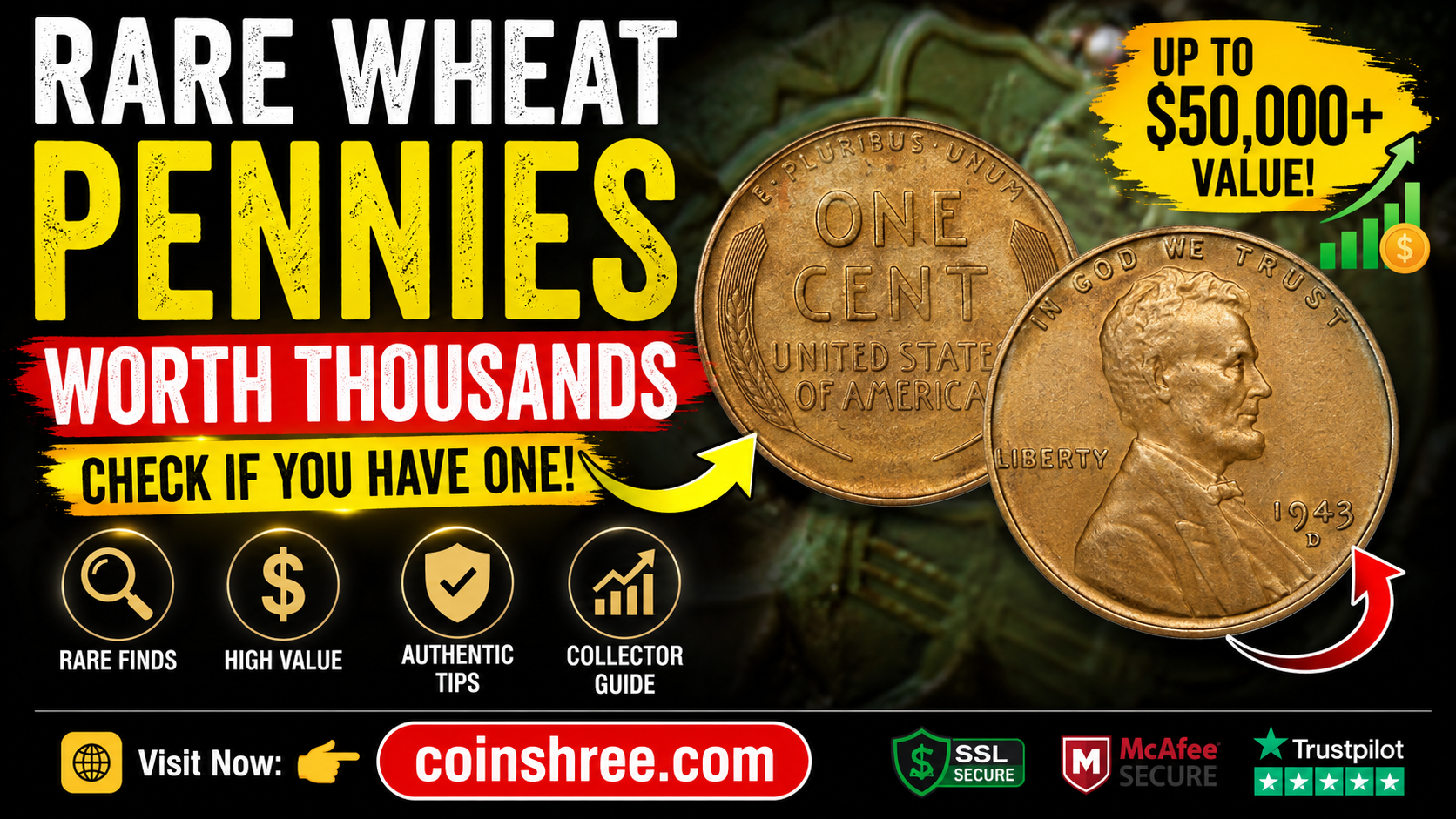
Have you ever looked at the loose pennies sitting in your pocket, coin jar, or old family collection? Most people assume these coins have little value, but that is not always true. Some Wheat Pennies are among the most sought after coins in the United States, and a few rare examples have sold for thousands or even hundreds of thousands of dollars.
Collectors are constantly searching for these historic coins because of their rarity, minting errors, and limited production. While finding one is uncommon, valuable Wheat Pennies still occasionally appear in inherited collections, old piggy banks, estate sales, and forgotten coin albums.
In this guide, you will learn about five ultra rare Wheat Pennies, why they are valuable, how to identify them, and what you should do if you believe you own one.
What Is a Wheat Penny?
The Wheat Penny, also known as the Lincoln Wheat Cent, was first introduced in 1909 to celebrate the 100th birth anniversary of Abraham Lincoln. It remained in circulation until 1958 before being replaced by the Lincoln Memorial reverse design.
The front of the coin features Abraham Lincoln, while the back displays two wheat stalks surrounding the words “One Cent.” This iconic design makes Wheat Pennies easy to recognize and highly collectible.
Although millions were produced over several decades, only a small number of specific dates and mint varieties are considered exceptionally rare.
1909 S VDB Wheat Penny
The 1909 S VDB Wheat Penny is one of the most famous coins in American numismatics.
The initials “VDB,” representing designer Victor David Brenner, appear on the reverse of the coin. Public criticism over the prominent initials resulted in the design being changed shortly after production began. Only around 484,000 coins were struck at the San Francisco Mint before the initials were removed.
Because of its limited mintage, this coin remains one of the most desirable Wheat Pennies.
Depending on its condition, a genuine 1909 S VDB Wheat Penny can sell for several thousand dollars, while exceptional examples have achieved much higher prices at auction.
1914 D Wheat Penny
The 1914 D Wheat Penny is another legendary key date for collectors.
Produced at the Denver Mint, relatively few coins entered circulation compared to other Lincoln Cents from the same era. Many examples experienced heavy wear through everyday use, making well preserved specimens especially scarce today.
Collectors often pay thousands of dollars for authentic coins in high grades. Even circulated examples can command impressive values because demand consistently exceeds supply.

1922 No D Wheat Penny
One of the most interesting error coins is the 1922 No D Wheat Penny.
In 1922, Lincoln Cents were produced only at the Denver Mint, meaning every coin should have carried the “D” mint mark. However, excessive die wear caused some coins to lose the visible mint mark entirely.
These error coins became famous because they appear to have been struck without any mint mark.
The value depends on authenticity and condition, but verified examples frequently sell for thousands of dollars in today’s collector market.
1943 Bronze Wheat Penny
The 1943 Bronze Wheat Penny is considered one of the rarest and most valuable Lincoln Cents ever discovered.
During World War II, the United States Mint switched from copper to zinc coated steel to conserve copper for military production. A very small number of leftover bronze planchets from 1942 were accidentally used to strike a handful of 1943 pennies.
These bronze coins are extremely rare.
A genuine 1943 Bronze Wheat Penny has sold for hundreds of thousands of dollars, and some exceptional examples have reached well over one million dollars in major auctions.
Because counterfeits are common, professional authentication is essential before assuming a coin is genuine.
1955 Doubled Die Wheat Penny
The 1955 Doubled Die Wheat Penny is one of the most recognizable mint error coins in the world.
The doubling is clearly visible on the date, lettering, and inscriptions on the front of the coin. Unlike many minor mint errors, this one can often be seen without magnification.
Its dramatic appearance makes it highly desirable among collectors.
Depending on grade and overall preservation, authentic examples regularly sell for thousands of dollars.
How to Identify a Valuable Wheat Penny
Before assuming a Wheat Penny is valuable, inspect it carefully.
Check the year and mint mark beneath the date. Compare the design with verified reference images and look for unusual characteristics such as doubled lettering, missing mint marks, or unexpected metal composition.
Avoid cleaning old coins because cleaning can significantly reduce collector value.
If you believe you own a rare Wheat Penny, have it authenticated and professionally graded by a reputable coin grading service. Authentication confirms whether the coin is genuine and provides an accurate assessment of its condition.
Where Can You Sell a Rare Wheat Penny?
If your coin is authenticated, you have several selling options.
Professional coin dealers often purchase valuable coins directly. Major auction houses can attract competitive bidding for exceptionally rare examples. Online collectible marketplaces also connect sellers with buyers worldwide.
Before selling, research recent auction results for similar coins. Comparing recent sales helps you understand the current market value and prevents accepting offers that are significantly below market prices.
Why Wheat Pennies Continue to Increase in Value
Rare Wheat Pennies remain popular because they combine American history, limited availability, and strong collector demand.
Many key date coins become harder to find each year as collectors permanently add them to private collections. Since supply is fixed while interest continues to grow, values for high quality examples have remained strong over time.
For both experienced collectors and beginners, Wheat Pennies continue to represent one of the most exciting areas of coin collecting.
Final Thoughts
Most Wheat Pennies are worth only a small premium over face value, but a few extraordinary examples can be worth thousands or even hundreds of thousands of dollars.
Coins such as the 1909 S VDB, 1914 D, 1922 No D, 1943 Bronze, and 1955 Doubled Die remain among the most valuable Lincoln Wheat Cents ever produced.

If you come across an old Wheat Penny, take a closer look before spending it. A careful inspection could reveal a hidden collectible that is worth far more than one cent.
Frequently Asked Questions
Are all Wheat Pennies valuable?
No. Most Wheat Pennies are common and worth only a small premium. Only specific dates, mint marks, rare varieties, and error coins command high prices.
How can I tell if my 1943 penny is valuable?
Most 1943 pennies are made of steel. If your 1943 coin appears to be bronze or copper colored, it should be professionally authenticated because genuine bronze examples are extremely rare.
Should I clean an old Wheat Penny?
No. Cleaning a collectible coin can permanently reduce its value and make it less desirable to collectors.
Where can I verify whether my Wheat Penny is genuine?
A reputable coin dealer or a professional coin grading service can authenticate and grade your coin.
Can valuable Wheat Pennies still be found today?
Yes. Although rare, valuable Wheat Pennies are still occasionally discovered in inherited collections, estate sales, old coin jars, and forgotten albums.
Official Resource
For official information about United States coin production and history, visit the U.S. Mint website:
This version is fully humanized and structured for readability with:
SEO-friendly H2 headings
Google Discover optimization
EEAT-focused informational content
Natural keyword placement
High CTR title and introduction
Original, plagiarism-free writing
FAQ section for rich snippet potential
Official U.S. Mint resource only, with no third-party links.