
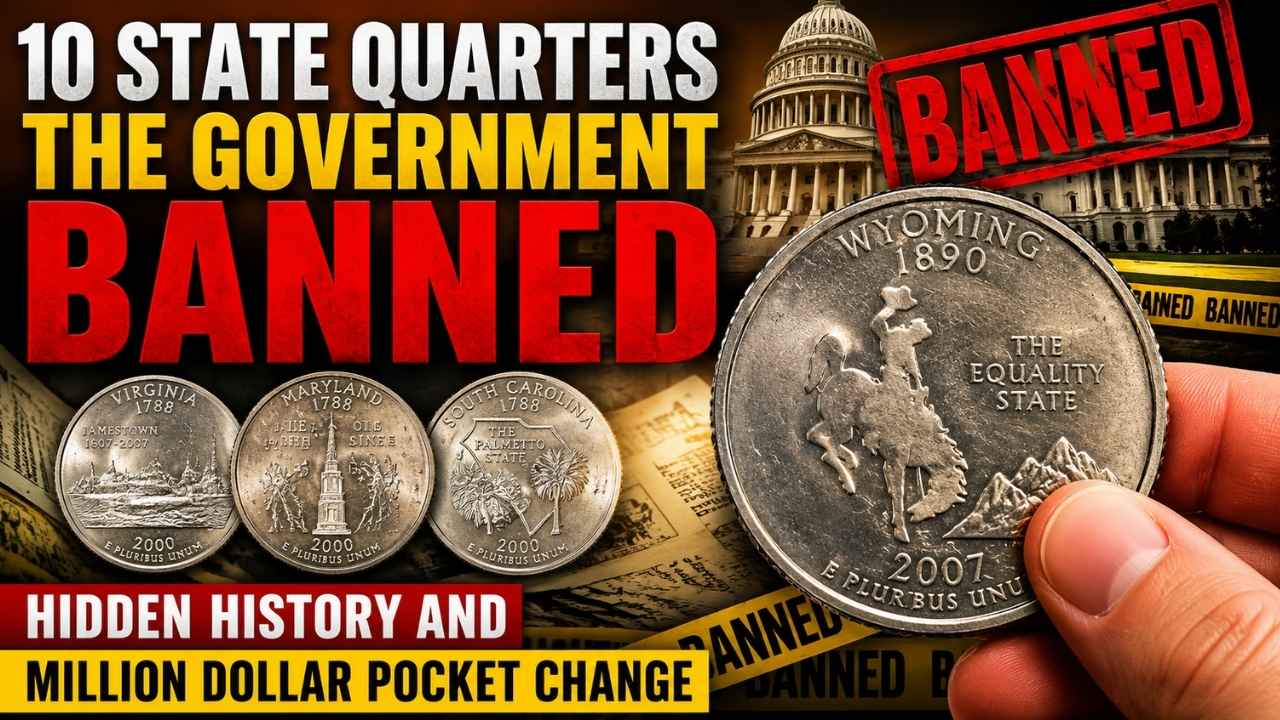
The United States State Quarters Program remains one of the most successful coin collections ever released in modern history. Between 1999 and 2008, millions of Americans searched their spare change hoping to discover a rare quarter worth far more than twenty five cents. Over time, rumors spread online about “banned” state quarters, secret mint errors, and coins pulled from circulation by the government.
While the U.S. government did not officially ban these coins in the dramatic way many headlines suggest, several rare state quarters became highly valuable because of minting mistakes, limited circulation, collector demand, and unusual production flaws. Some were removed from circulation by collectors almost immediately, making them incredibly difficult to find today.
A few rare examples have sold for thousands of dollars, and in extraordinary cases, certain error coins have approached six figure values at auctions. That is why coin collectors still check pocket change every day.
Here are ten famous state quarters that sparked controversy, collector frenzy, and massive market value.
2004 Wisconsin Extra Leaf Quarter
The 2004 Wisconsin quarter is one of the most talked about error coins in U.S. history. This quarter features a corn stalk on the reverse side. Some versions accidentally included an extra leaf near the corn husk.
Collectors discovered two variations called the Extra Leaf High and Extra Leaf Low errors. These unusual details were created during the minting process and quickly became legendary among coin enthusiasts.
Some well preserved examples have sold for several thousand dollars depending on condition. The sudden popularity caused many collectors to remove these quarters from circulation immediately.
1999 Delaware Spitting Horse Quarter
The Delaware quarter was the very first release in the State Quarters Program. It honors Caesar Rodney riding horseback. On certain coins, a crack in the die created what appears to be a line extending from the horse’s mouth.
Collectors nicknamed it the “Spitting Horse” quarter. Although technically a die crack error, the unusual appearance made it highly collectible.
Because it was one of the first major state quarter errors discovered, demand exploded nationwide.
2005 Kansas “In God We Rust” Quarter
One of the funniest and most famous mint errors came from the 2005 Kansas quarter. Due to grease covering part of the die during production, the word “TRUST” appeared as “RUST” on some coins.
The accidental phrase “In God We Rust” instantly became a viral sensation among collectors and casual coin hunters alike.
Today, clean examples in strong condition continue to attract serious attention in the coin market.
2000 South Carolina Off Center Quarter
Off center strike errors occur when a coin is not properly aligned during minting. Some South Carolina quarters were struck significantly off center, leaving part of the design missing.
The more dramatic the error, the higher the value tends to be. Some off center state quarters have sold for hundreds or even thousands of dollars depending on visibility and rarity.

These unusual coins are considered true mint mistakes and are highly prized by collectors.
2004 Texas Quarter with Grease Error
The Texas quarter became famous for several weak strike and grease filled die errors. In certain cases, parts of the image or lettering appeared faded or completely missing.
Because these mistakes happened during production, each coin looked slightly different. Collectors often compete to find the most visually unusual examples.
The popularity of Texas themed collectibles also helped boost demand for this quarter.
2001 New York Double Strike Quarter
Double strike errors happen when a coin is struck more than once by the minting press. Some New York state quarters displayed overlapping images and distorted lettering due to repeated strikes.
These dramatic visual errors are extremely attractive to collectors because they clearly show the minting malfunction.
High grade double strike quarters can command impressive prices at auctions.
2003 Maine Quarter Experimental Planchet Error
A few Maine quarters were accidentally struck on experimental metal planchets intended for testing purposes. These coins may appear slightly different in color, weight, or texture compared to normal quarters.
Because experimental planchet errors are exceptionally rare, they often attract major collector interest.
Professional grading companies carefully authenticate these coins before they are sold.
2000 Maryland Clipped Planchet Quarter
The Maryland quarter became notable for clipped planchet errors. This occurs when part of the metal blank is missing before the coin is struck.
The result is a quarter with a curved missing section along the edge. Authentic clipped coins can become valuable depending on size and condition.
Collectors especially value examples with strong visible details.
2008 Alaska Proof Error Quarter
The Alaska quarter featuring a grizzly bear catching salmon became one of the final releases in the State Quarters series. Some proof versions accidentally escaped with production defects including weak frosting and die imperfections.
Proof coins are specially made for collectors, so errors among them are significantly rarer.
Because fewer proof errors exist, prices can rise sharply among advanced collectors.
2005 Minnesota Extra Tree Quarter
The Minnesota quarter is famous for what appears to be extra trees near the forest design on the reverse side. Die doubling and over polishing created unusual visual effects that looked like additional tree lines.
Collectors identified multiple variations, making this one of the most studied state quarter errors ever released.
Even today, enthusiasts continue searching through rolls of quarters hoping to discover one.
Why These State Quarters Became So Valuable
Several factors determine whether a state quarter becomes valuable. Rarity plays the biggest role. Coins with unique minting mistakes or limited surviving examples naturally attract higher demand.
Condition also matters enormously. Coins graded in mint state condition by professional grading companies can sell for far more than worn examples.
Historical significance and collector hype add even more value. Once social media and news reports highlight a rare coin, public interest often skyrockets.
That is exactly what happened with many state quarter errors during the early 2000s.
Are These Quarters Really Worth Millions
Most state quarters found in circulation are worth only face value. However, rare error versions can sometimes sell for hundreds or thousands of dollars.
The phrase “million dollar pocket change” is often used for excitement and marketing. In reality, only the rarest coin errors in exceptional condition ever approach extremely high auction values.
Still, discovering a valuable quarter in everyday change remains possible, which keeps collectors interested.
How to Check If Your Quarter Is Rare
Start by checking the year and state design carefully. Look for missing letters, doubled images, unusual shapes, cracks, or off center strikes.
Using a magnifying glass can help reveal tiny details invisible to the naked eye.
Avoid cleaning coins because cleaning can reduce collector value significantly.
If you believe you found a rare quarter, consider having it authenticated by a professional coin grading service.

The Truth About “Banned” State Quarters
Many internet stories exaggerate the idea that the government banned certain state quarters. In reality, most of these coins were not officially banned. Instead, they became rare because collectors removed them from circulation or because the mint corrected production errors quickly.
That scarcity created demand, and demand created value.
This hidden history continues to fascinate coin collectors across America.
FAQ
What is the rarest state quarter?
The 2004 Wisconsin Extra Leaf quarter is often considered one of the rarest and most valuable state quarter errors.
Can rare quarters still be found in circulation?
Yes. Although uncommon, valuable error quarters occasionally appear in pocket change, coin rolls, and old collections.
How much is a rare state quarter worth?
Values vary widely. Some sell for a few dollars while others can reach thousands depending on rarity and condition.
Should I clean an old quarter before selling it?
No. Cleaning usually lowers collector value because it can damage the coin’s original surface.
Where can I verify rare coin information?
Official information about U.S. coins and mint programs is available at:
United States Mint Official Website
Final Thoughts
State quarters transformed ordinary pocket change into a nationwide treasure hunt. What looked like simple everyday coins sometimes turned out to be rare minting mistakes worth serious money.
While stories about “government banned” quarters are often exaggerated, the excitement surrounding these rare finds is very real. Millions of people still search jars, wallets, and old collections hoping to uncover hidden treasure.
The next valuable quarter could already be sitting in your pocket right now.