
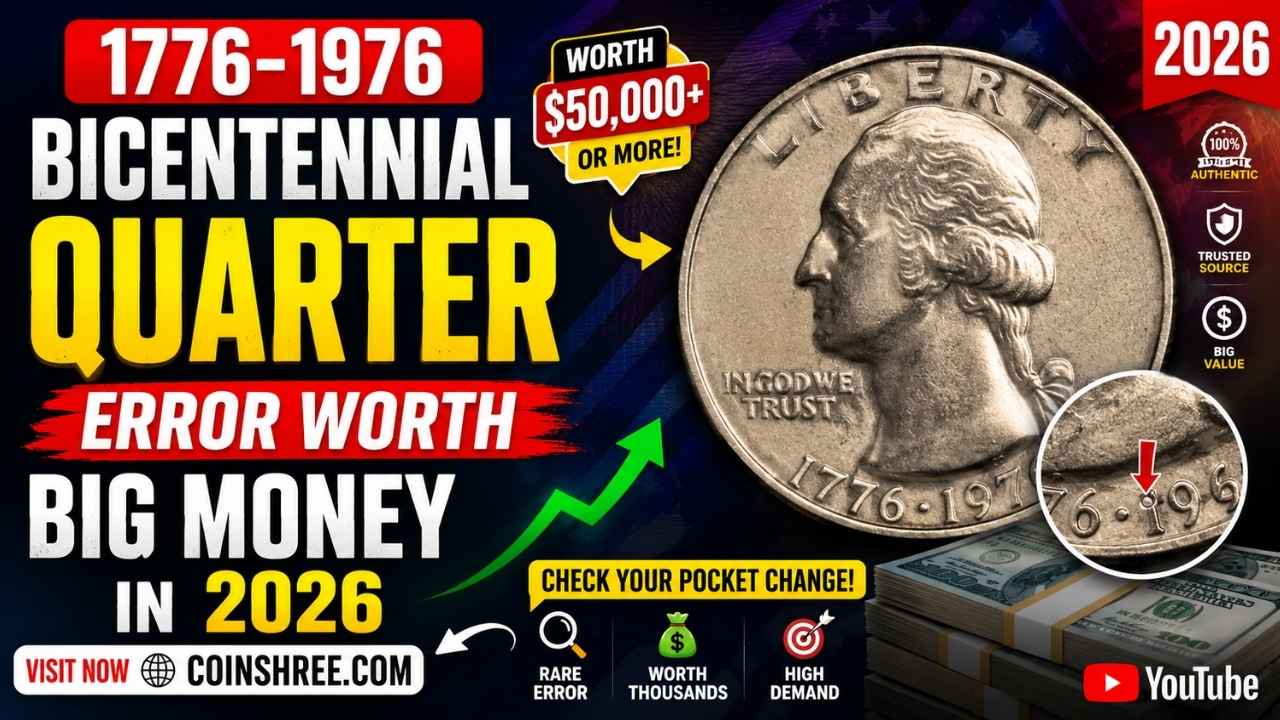
The 1776–1976 Bicentennial Quarter is one of the most recognizable coins in American history. Created to celebrate 200 years of American independence, this special quarter features the dual date 1776–1976 and a unique colonial drummer design on the reverse. Millions of Americans still have one tucked away in jars, drawers, and old collections. But here is the big question people are asking in 2026. Could your Bicentennial Quarter be worth far more than twenty five cents?
The answer is yes, but only under specific conditions. While most Bicentennial quarters are common and worth face value, certain rare error versions and high grade specimens are now attracting serious attention from collectors. Some have sold for hundreds and even thousands of dollars at auction.
Let’s explore everything you need to know from A to Z.
Why the 1776–1976 Quarter Was Created
In 1975 and 1976, the United States Mint released special coins to honor the country’s Bicentennial celebration. Instead of the standard eagle reverse design, the quarter featured a colonial drummer with a torch surrounded by thirteen stars. The obverse still showed George Washington, but the date was changed to 1776–1976 to mark the anniversary.
No quarters were dated 1975. All quarters struck in those two years carry the dual date.
These coins were minted in Philadelphia, Denver, and San Francisco. The San Francisco Mint also produced proof versions and special 40 percent silver editions for collectors.
Because more than 1.6 billion Bicentennial quarters were produced, most examples are extremely common. However, rare mint errors and pristine condition coins are a different story.
What Makes a Bicentennial Quarter Valuable in 2026
Coin values are driven by rarity, demand, condition, and uniqueness. In 2026, as the 250th anniversary of American independence approaches, interest in patriotic collectibles is increasing. That renewed attention is pushing certain Bicentennial quarter errors into the spotlight.
Here are the main factors that can make one valuable:
Mint Errors
Coins with striking mistakes are highly collectible. These errors happen during production and are not intentional.
Silver Composition
Some Bicentennial quarters were struck in 40 percent silver. These were mostly produced in San Francisco and sold in collector sets. Silver content alone gives them higher intrinsic value.
High Grade Condition
Coins graded MS67 or higher by professional grading services can sell for significant premiums.

Proof Errors
San Francisco proof quarters with visible errors can command strong prices among specialized collectors.
Rare Bicentennial Quarter Errors to Watch For
Not every unusual looking coin is valuable. But certain verified errors have brought impressive results.
Double Die Errors
This occurs when the die strikes the coin more than once at slightly different angles, causing visible doubling in the lettering or date. Strong doubling is rare and desirable.
Off Center Strikes
If the coin design appears shifted to one side, leaving part of the blank planchet visible, it may be an off center error. The more dramatic the shift, the more valuable it can be.
Clipped Planchet
A clipped planchet error happens when a portion of the metal blank is missing before striking. These are easy to identify because part of the coin edge will look curved or cut away.
Wrong Planchet Errors
Some Bicentennial quarters have been discovered struck on planchets meant for other denominations. These are extremely rare and can be worth thousands.
No Mint Mark Proof Coins
Certain proof coins missing the expected mint mark can bring premium prices if authenticated.
How Much Are They Worth in 2026
Most circulated Bicentennial quarters are still worth twenty five cents.
However, here is a general value breakdown:
Circulated standard clad coins
Face value
Uncirculated high grade coins
Five to fifty dollars depending on condition
40 percent silver versions
Ten to twenty dollars or more depending on silver prices
Verified mint error coins
Hundreds to several thousand dollars
Auction records show that top graded examples with unique errors have crossed the thousand dollar mark. The highest prices are usually achieved when coins are professionally graded and preserved in near perfect condition.
How to Check If Your Quarter Is Valuable
If you think you have a special Bicentennial quarter, follow these steps:
First examine the edge. A silver version will have a solid silver colored edge. Standard clad coins show a copper stripe.
Next look closely at the lettering and date for doubling.
Check for unusual shapes, missing elements, or off center designs.
Weigh the coin. A standard clad quarter weighs about 5.67 grams. A 40 percent silver quarter weighs slightly more at around 5.75 grams.
Finally consider professional grading. Trusted services like PCGS or NGC can authenticate errors and assign condition grades, which significantly impacts market value.
Avoid cleaning the coin. Cleaning can damage the surface and reduce value dramatically.
Are These Coins Really Selling for Big Money
Yes, but only rare examples. Social media headlines often exaggerate values, suggesting every Bicentennial quarter is worth thousands. That is not accurate.
Serious collectors pay strong prices for coins that are:
Authenticated
In exceptional condition
Featuring legitimate mint errors
Rare in the marketplace

The majority of Bicentennial quarters in everyday circulation remain common.
Why Interest Is Rising in 2026
As America approaches its 250th anniversary in 2026, patriotic memorabilia is experiencing renewed interest. Collectors are revisiting coins from the 1976 Bicentennial celebration, creating fresh demand.
Milestone anniversaries often spark media attention, which leads to increased online searches and auction activity. When public interest grows, rare variations naturally see price momentum.
Frequently Asked Questions
Are all 1776–1976 quarters valuable
No. Most are worth face value unless they are silver, uncirculated in high grade, or contain verified mint errors.
How do I know if my quarter is silver
Check the edge. If there is no copper stripe and the coin weighs slightly more than normal, it may be silver.
What is the rarest Bicentennial quarter error
Wrong planchet errors and dramatic double die examples are among the rarest and most valuable.
Should I sell now or wait
Market timing depends on demand trends. With 2026 bringing patriotic focus, interest may remain strong, but long term rarity ultimately drives value.
Where can I sell a valuable coin
Reputable coin dealers, major auction houses, and certified online marketplaces are common selling options. Authentication is strongly recommended before selling.
Final Thoughts
The 1776–1976 Bicentennial Quarter remains a fascinating piece of American history. While most examples are common, rare errors and high grade coins can indeed be worth big money in 2026. The key is understanding what to look for and separating hype from reality.
If you have one sitting at home, it is worth taking a closer look. That ordinary looking quarter could turn out to be a collectible treasure.