
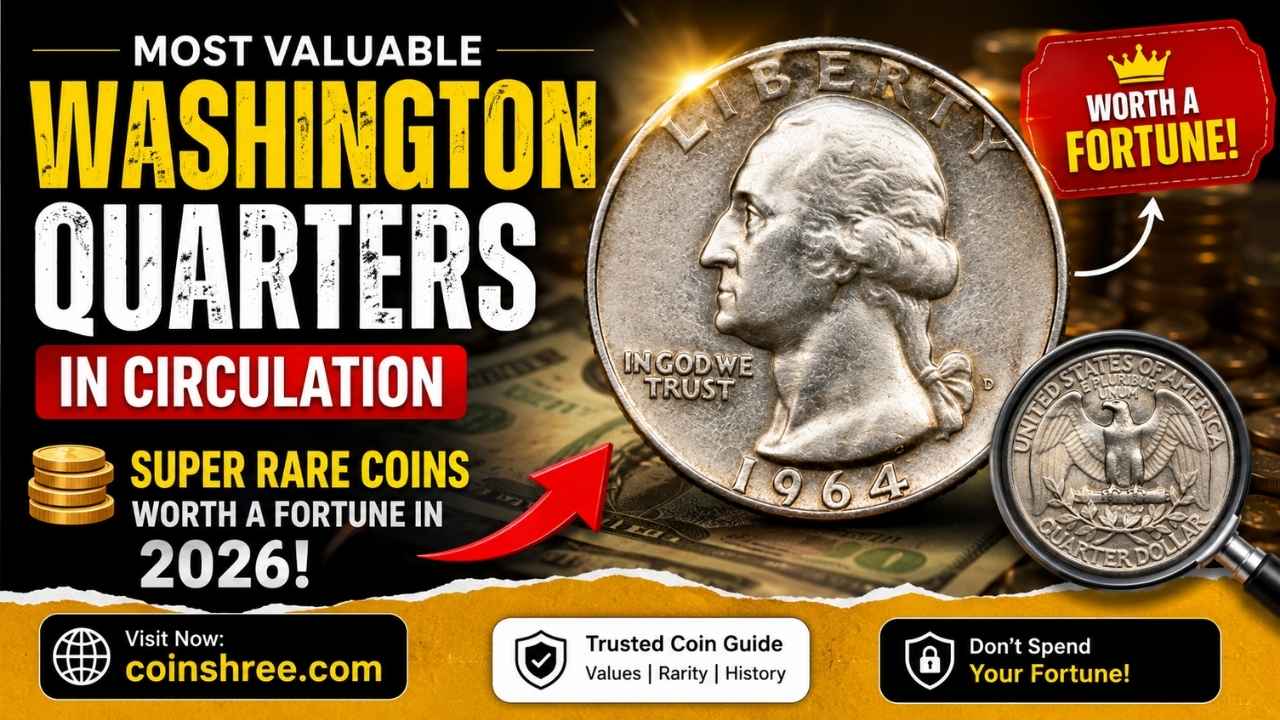
For decades, Washington quarters have been one of the most common coins in American pockets, piggy banks, and cash registers. Most people never give them a second glance. Yet a few rare Washington quarters hiding in circulation today could be worth hundreds, thousands, or even life changing amounts of money in 2026.
Coin collectors across the United States continue searching for these valuable quarters because certain minting errors, low production years, silver content, and rare variations can turn a simple 25 cent coin into a collector’s dream. Some of these quarters have sold for astonishing prices at auctions, while others are still being discovered in everyday change.
If you have an old jar of coins at home or regularly handle cash, this could be the perfect time to start checking your quarters carefully. One rare coin could completely surprise you.
Why Some Washington Quarters Are Worth So Much
The value of a Washington quarter depends on several important factors. Age alone does not always make a coin valuable. Instead, collectors look for rarity, minting errors, condition, and historical significance.
Quarters produced in limited numbers are naturally harder to find, which increases demand among collectors. Coins with printing mistakes or unusual features are also extremely valuable because they are considered rare mint errors.
Silver quarters minted before 1965 are especially popular because they contain 90 percent silver. As silver prices continue rising in 2026, these coins remain highly desirable.
Condition matters as well. A quarter that looks nearly untouched can be worth dramatically more than one that is heavily worn from circulation.
The 1932 D Washington Quarter
The 1932 D Washington quarter is one of the most famous key date coins in the entire series. Minted in Denver during the first year of Washington quarter production, this coin had a very low mintage.
Collectors aggressively hunt for this quarter because only a small number were produced compared to later years. Even heavily circulated examples can sell for hundreds of dollars, while coins in excellent condition may reach several thousand dollars.
You can identify this coin by looking for the small “D” mint mark on the reverse side beneath the eagle.
The 1932 S Washington Quarter
Another legendary coin is the 1932 S Washington quarter. Like the Denver version, this San Francisco minted quarter had extremely limited production.
Finding one in circulation today is rare, but it still happens occasionally when old collections are unknowingly spent. Coin experts consider this one of the most essential coins for serious Washington quarter collectors.
Depending on condition, values can range from several hundred dollars to over $10,000 for exceptional examples.
The 1943 Double Die Quarter
The 1943 Washington quarter is famous for a striking minting error called a double die. This occurs when the design is accidentally stamped twice at slightly different angles.
Collectors should carefully examine the lettering and date on the coin. If the doubling is clearly visible, the quarter may be highly valuable.
Because wartime coins already carry historical interest, error versions from the 1940s attract strong collector demand. Rare high grade examples have sold for thousands of dollars.
The 1950 D Over S Quarter
One of the most fascinating mint errors in U.S. coin history is the 1950 D over S Washington quarter. This coin was created when a Denver mint mark was stamped over a San Francisco mint mark.
Under magnification, traces of the underlying “S” can still be seen beneath the “D.” Error coin collectors consider this one extremely desirable.
Even circulated versions can command impressive prices in today’s market, and premium quality specimens may sell for several thousand dollars in 2026.
The 1964 Silver Washington Quarter
The 1964 Washington quarter may appear ordinary, but it was the final year the U.S. Mint produced quarters with 90 percent silver for regular circulation.
Millions were made, yet many remain valuable because of their silver content. In excellent condition, certain 1964 quarters can be worth far more than face value.
Special proof versions and coins with rare errors are even more valuable. As silver prices remain strong in 2026, demand for these quarters continues growing among collectors and investors alike.
The 1970 S Proof Quarter Error
The 1970 S proof Washington quarter is another coin that has gained attention due to unusual minting mistakes. Some versions were mistakenly struck over older Canadian coins, creating dramatic and rare error pieces.
These unique quarters are considered major collector discoveries and have sold for tens of thousands of dollars at auction.
Although finding one in circulation is highly unlikely, collectors still examine proof sets and inherited coin collections hoping for a surprise discovery.
State Quarters With Rare Errors
The U.S. State Quarters Program created a massive wave of coin collecting excitement beginning in 1999. While most state quarters are common, a few error versions are worth substantial money today.
Some of the most famous examples include:
1999 Delaware Spitting Horse quarter
2004 Wisconsin Extra Leaf quarter
2005 Kansas In God We Rust quarter
These coins became famous because of unusual minting defects that created distinctive visual differences. Depending on rarity and condition, some examples now sell for hundreds or thousands of dollars.
How to Check If Your Quarter Is Valuable
Checking your quarters is easier than many people think. Start by looking at the date and mint mark. The mint mark is usually a small letter indicating where the coin was made.
Next, inspect the coin carefully for unusual details such as doubled text, missing letters, strange shapes, or design abnormalities.
Using a magnifying glass can help reveal hidden errors that are difficult to spot with the naked eye.
Collectors should also pay attention to silver quarters minted before 1965 because they often carry value beyond their face amount.
If you believe you found a rare quarter, consider having it professionally graded and authenticated by a reputable coin grading service.
Why Rare Coin Values Keep Rising in 2026
Rare coin collecting continues growing rapidly in 2026 because more people are viewing collectible coins as both historical treasures and alternative investments.
Economic uncertainty, rising precious metal prices, and social media driven collecting trends have increased interest in valuable U.S. coins. Viral stories about rare quarters found in circulation have encouraged millions of people to check their spare change more carefully than ever before.
At the same time, the supply of rare coins remains limited, which naturally pushes prices higher when collector demand increases.

Final Thoughts
Washington quarters may seem ordinary, but some hidden gems are still circulating today. Rare dates, silver content, mint errors, and limited production numbers can transform a simple quarter into a highly valuable collectible worth a fortune in 2026.
Whether you are an experienced collector or simply curious about the coins in your pocket, taking a closer look at your quarters could be surprisingly rewarding.
Many valuable coins have been discovered by ordinary people who almost spent them without realizing their true worth.
FAQs
Which Washington quarter is the rarest?
The 1932 D and 1932 S Washington quarters are considered among the rarest and most valuable regular circulation Washington quarters.
Are quarters before 1965 worth money?
Yes. Most quarters minted before 1965 contain 90 percent silver, making them worth significantly more than face value.
What mint errors should I look for on quarters?
Collectors commonly search for double dies, off center strikes, over mint marks, missing letters, and unusual design features.
Can rare quarters still be found in circulation?
Yes. Although uncommon, valuable quarters are still occasionally discovered in pocket change, bank rolls, and old coin jars.
Where can I verify a rare quarter?
Collectors can verify coins through professional grading services and the official U.S. Mint website.
Official Source: United States Mint