
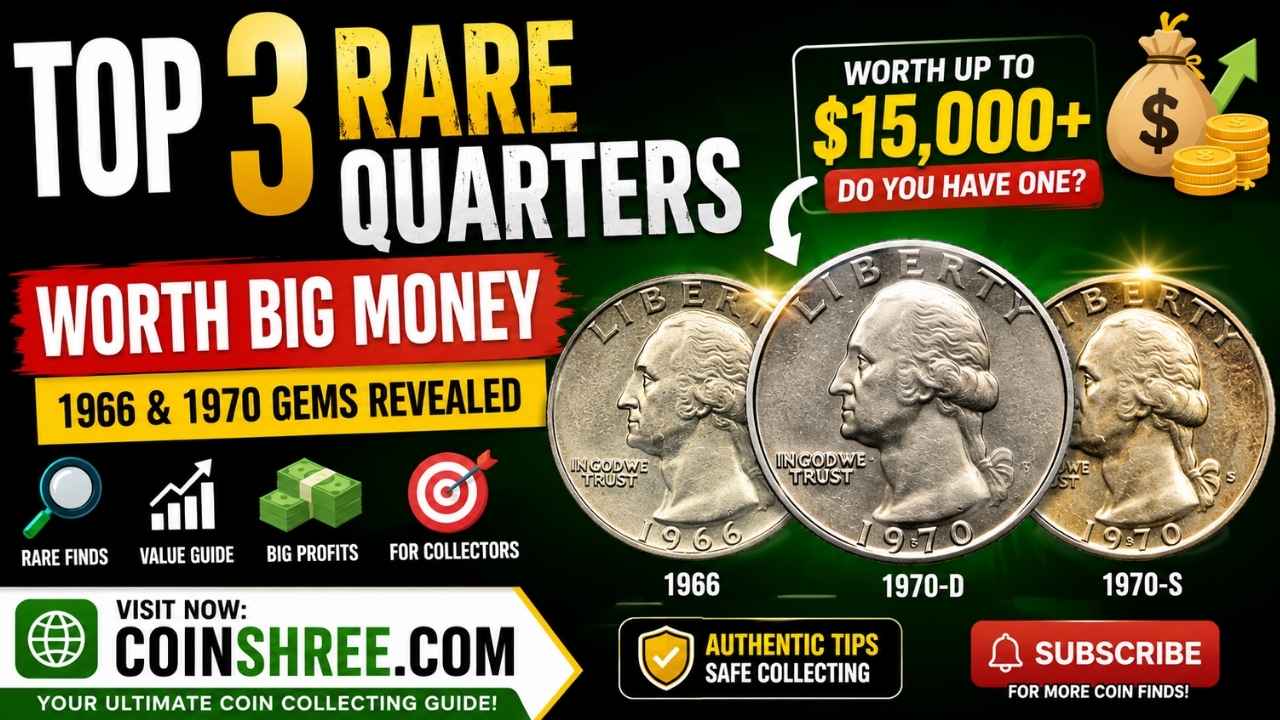
Rare quarters have fascinated collectors and everyday Americans for decades. What appears to be simple pocket change can sometimes hold surprising value. Among the most talked about coins are the 1966 and 1970 Washington quarters. While millions were minted, a few rare gems from these years have sold for thousands of dollars due to unique characteristics, mint errors, or exceptional condition.
If you have old quarters sitting in a jar, wallet, or inherited collection, this guide will walk you through everything you need to know. From mint marks and grading to errors and authentication, we cover every detail so you can identify whether your coin is worth face value or far more.
Why Rare Quarters Can Be Extremely Valuable
The value of a quarter depends on rarity, condition, historical importance, and demand. Coins become rare for several reasons. Some were produced in limited quantities. Others contain minting errors that were never meant to leave the mint. A few survive in pristine condition, known as Mint State, which dramatically increases their price.
Professional grading services evaluate coins on a scale from 1 to 70. A coin graded MS67 or higher can sell for exponentially more than one graded MS63. Even small differences in surface quality, luster, and strike sharpness can impact value significantly.
Understanding these factors is essential before assuming any quarter is valuable.
The 1966 Washington Quarter Gem
The 1966 Washington quarter is unique because it was produced during a transitional period in American coinage. From 1965 through 1967, the United States Mint removed mint marks from coins to discourage hoarding. As a result, 1966 quarters do not carry mint marks, regardless of where they were produced.
Most 1966 quarters are common and worth only face value in circulated condition. However, certain high grade examples and error coins have sold for impressive amounts.
One major factor is condition. A 1966 quarter graded MS67 or higher is extremely scarce. These coins feature sharp details in George Washington’s hair, strong luster, and virtually no contact marks. In top condition, they can fetch thousands of dollars at auction.
Another valuable variation is the doubled die error. This occurs when the coin design is impressed twice slightly off alignment, creating a visible doubling effect in letters or numbers. Collectors actively seek strong doubled die examples from 1966.
Additionally, off center strikes and clipped planchet errors can increase value significantly. Even small mint mistakes make these quarters highly collectible.
If you suspect you have a rare 1966 quarter, professional grading is strongly recommended.

The 1970 Quarter That Collectors Hunt For
At first glance, the 1970 Washington quarter may not seem special. Millions were minted, and most remain common today. However, a specific variation known as the 1970 S proof quarter struck on a 1941 Canadian quarter is one of the most famous mint errors in modern coin collecting.
This extraordinary error happened when a leftover Canadian silver quarter planchet was accidentally used to strike a 1970 S proof Washington quarter. The result is a fascinating hybrid coin that shows traces of the underlying Canadian design.
Only a very small number of these error coins exist, and they have sold for tens of thousands of dollars at auction.
Regular 1970 quarters can also carry value if they are in superb Mint State condition. High grade examples with full strike details and flawless surfaces can command premium prices.
Proof quarters from 1970 produced in San Francisco are also collectible, especially if they show deep cameo contrast between frosted design elements and mirror like backgrounds.
Collectors carefully examine the coin’s edge, weight, and metal composition to detect unusual errors or striking anomalies.
How to Identify a Valuable 1966 or 1970 Quarter
Start by checking the coin’s overall condition. Look for minimal scratches, strong luster, and sharp details. Coins with dull surfaces and heavy wear are generally not valuable.
Next, inspect the lettering and numbers closely. Use a magnifying glass to check for doubling effects, misalignment, or unusual spacing.
Weigh the coin if possible. A standard clad quarter weighs 5.67 grams. Any noticeable deviation could indicate an error planchet.
Check the edge. Clad quarters have a visible copper stripe along the edge. If the edge appears entirely silver without copper, further investigation is needed.
Finally, consider professional grading. Services such as PCGS and NGC authenticate and assign official grades, which significantly impact resale value.
For accurate minting standards and official specifications, you can refer to the United States Mint.
What Makes High Grade Coins So Rare
Many people wonder why high grade coins are worth so much when millions were produced. The answer lies in survival rates.
Coins are made for circulation. They are used in transactions, dropped, stacked, and stored loosely. This constant contact creates scratches and wear. Very few coins remain untouched in pristine condition for decades.
A 1966 or 1970 quarter graded MS68 is far rarer than the mintage number suggests. Collectors pay a premium for coins that appear almost perfect under magnification.
Original mint luster, crisp strike details, and clean fields are essential characteristics of high grade coins.
How to Store and Protect Rare Quarters
If you discover a potentially valuable coin, proper storage is critical.
Avoid cleaning the coin. Cleaning can cause microscopic scratches that drastically reduce value.
Store the coin in a protective holder made from non PVC materials. Keep it in a cool, dry place away from humidity and extreme temperature changes.
If the coin appears especially rare or valuable, submit it to a professional grading service for authentication and encapsulation.
Proper handling can preserve value for decades and even generations.
Where to Sell Rare Quarters
Once authenticated, rare quarters can be sold through coin dealers, major auction houses, or online marketplaces specializing in numismatics.

Auction houses often generate the highest prices for exceptional coins due to competitive bidding. However, dealer sales offer quicker transactions.
Always research recent auction results to understand current market demand before selling.
Frequently Asked Questions
Are all 1966 quarters valuable
No. Most circulated 1966 quarters are worth only 25 cents. Only high grade examples or those with significant mint errors carry substantial value.
How much is a 1970 quarter worth today
A regular circulated 1970 quarter is typically worth face value. High grade Mint State or rare error versions can be worth hundreds or even thousands of dollars.
What is the rarest 1970 quarter
The 1970 S proof quarter struck on a Canadian quarter planchet is among the rarest and most valuable known examples.
Should I clean my old quarter before selling it
No. Cleaning almost always lowers a coin’s value. Collectors prefer coins in original condition.
How can I know if my coin is authentic
Professional grading services authenticate coins. Certification provides assurance and often increases market value.
Final Thoughts on 1966 and 1970 Rare Quarters
The 1966 and 1970 Washington quarters prove that hidden treasures can exist in everyday change. While most are common, a select few in exceptional condition or with rare mint errors are worth significant money.
Careful inspection, proper storage, and professional grading are key steps in determining true value. Before spending old quarters, take a closer look. That small silver colored coin could be worth far more than twenty five cents.
Collectors continue to hunt these rare gems, and the market remains strong for high quality examples. With knowledge and patience, you might uncover a valuable piece of American coin history right in your own collection.